
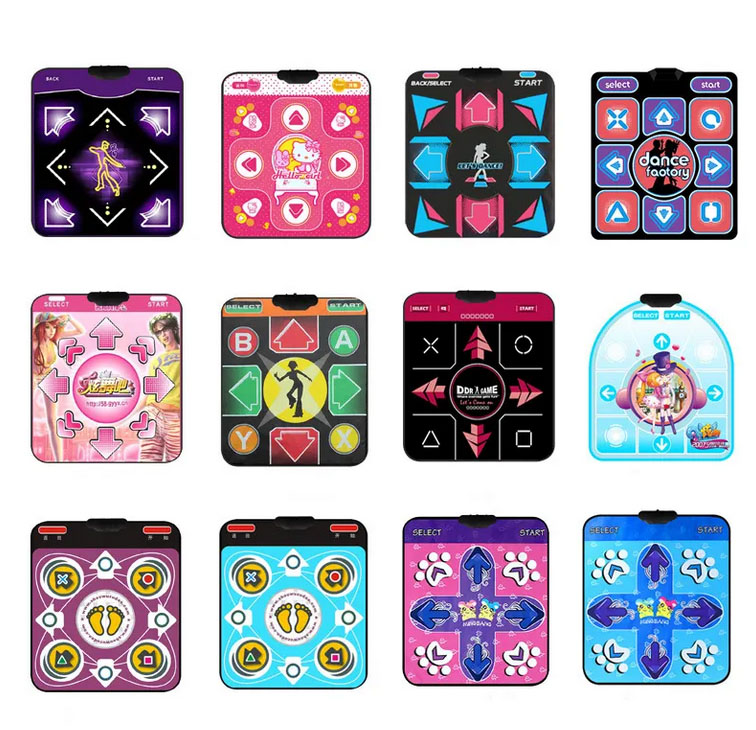
Customising a dance mat is not one decision but five: the printed surface, the sensor and foam stack, the console hardware, the firmware, and the packaging. Each layer has its own MOQ threshold, its own approval step and its own way of going wrong. Importers who treat "custom dance mat" as a single checkbox usually discover the split the expensive way — after the deposit.
This guide walks through each layer, what it realistically costs in MOQ and lead time, and the approval workflow that keeps a custom project on schedule. If you are still choosing a supplier first, read how to choose a dance mat manufacturer, and for the money side use our free landed cost calculator once you have a quote.
1. The five customisation layers
A dance mat is a stack of technologies, and each layer can be customised independently:
- Mat surface and print. Artwork, arrow layout, colour scheme, logo placement, surface material (flannel, PU, PVC) and thickness. The lowest-cost, lowest-MOQ layer because it is a print change, not a tooling change.
- Foam and sensor stack. Foam density, mat thickness, sensor sensitivity zones and the anti-slip base. Medium MOQ — changing the stack affects cutting patterns and QC test limits.
- Console hardware. Button layout, enclosure colour, connector set (HDMI/AV, USB), and whether a rechargeable battery is fitted. Custom enclosures require tooling and push MOQ sharply upward.
- Firmware. Song library, language of voice prompts and menus, game modes, volume curve, boot logo. Firmware changes are cheap in tooling terms but consume engineering and testing time — and raise the most QA questions.
- Packaging. Colour box artwork, dieline, insert, language, barcodes, warnings. MOQ is driven by the print run, typically the second-highest hurdle after surface print.
Before asking for "full custom", decide which layers actually move the needle in your market. In most retail channels, surface print + packaging + firmware language deliver 80% of the shelf impact for 20% of the MOQ pain.
2. MOQ and cost by customisation level
Typical figures for a mature OEM line, so you can sanity-check quotes:
| Customisation level | Typical MOQ | Tooling / setup | Extra lead time |
|---|---|---|---|
| Logo on existing mat surface | 300–500 pcs | Screen or digital print setup only | +3–5 days |
| Full surface artwork + colour box | 500–1,000 pcs | Print setup, no mould | +7–12 days |
| Surface + packaging + firmware language | 1,000 pcs | Firmware build and QA regression | +10–15 days |
| Custom console enclosure / battery option | 3,000+ pcs | Mould, electrical re-certification | +30–45 days |
| New sensor layout or mat size | 3,000–5,000 pcs | Cutting jigs, sensor calibration, re-test | +35–50 days |
Two rules protect your margin here. First, get the MOQ per level quoted separately — a lump-sum "custom" quote hides which layer is driving the number. Second, ask what happens on reorders: tooling amortised into the first order should not reappear on the second, and the print setup for your artwork should be kept on file.
3. The artwork and approval workflow
A disciplined custom run follows a fixed sequence. Skipping a step is how you end up with 2,000 units of the wrong blue:
- Vector artwork in. You supply the logo and graphics in AI/PDF vector format, with Pantone (PMS) numbers for any brand colour. JPEG logos will be redrawn, and each redraw is a chance for drift.
- Factory mock-up. The factory returns a digital mock-up of the mat surface and the colour box, showing your artwork on the actual dieline — including the seams, corners and warning-label areas that mock-ups drawn off-dieline always get wrong.
- Pre-production sample (PPS). One real unit, printed with your artwork, on the real material. This is the reference unit. Sign it or mark corrections in writing.
- Golden sample retained by both sides. The signed PPS becomes the arbitration standard for the shipment. Without it, a quality dispute has no referee.
- Production against the golden sample. QC compares mass-production units to the sample, not to a screen.
Budget 15–25 working days from artwork handover to approved PPS. If a supplier promises a production-line sample in 3 days, you are being sent a stock unit with a sticker on it.
4. Firmware and the song library
Firmware is where custom dance mat projects are most under-specified. Decide in writing, before the deposit:
- Song library size and composition — and the licensing status of every track. A factory offering "200 hit songs" is either licensing them (ask for proof) or exposing you to a takedown risk in your market.
- Languages for menus and voice prompts, including accent and gender preferences for recorded prompts.
- Game modes — single player, two-player versus, exercise mode, level progression — and whether your market needs any mode added.
- Version lock. Insist the firmware version is written on the PI and that reorders ship the same version unless you approve a change. Silent firmware swaps between batches cause "it worked last time" complaints that are nearly impossible to diagnose downstream.
5. Packaging: where custom projects go wrong
Dance mats are large, light and soft — a freight profile that punishes packaging twice. The colour box must survive the container and the courier, and it must not inflate the chargeable volume more than it has to.
- Ask for carton dimensions, gross weight and units per carton with the quote — these three numbers decide your freight per piece more than the FOB price does.
- Insist on an edge-crush-rated box and an inner bag; folded mats arrive with permanent creases when the box is decorative rather than structural.
- If you sell on marketplaces, add a drop-test requirement: the packaged unit survives a 76 cm drop on all faces. This is the standard parcel-network reality, not gold-plating.
- Multi-language warnings and safety marks must be on the box before printing, not corrected with stickers afterwards.
6. Five mistakes first-time buyers make
- Customising everything at once. Start with surface print + packaging on a proven model; move to hardware customisation only after the first sell-through.
- No golden sample. Disputes without a signed reference unit resolve in favour of whoever shouts louder.
- Ignoring song licensing. The factory's legal exposure becomes yours the moment the product carries your brand.
- Approving artwork by chat message. approvals belong in signed PDFs with revision numbers.
- Forgetting the reorder. Print setups, firmware builds and tooling should be kept on file; ask the factory to confirm this in writing, or your second order quietly becomes a first order again.
How STEP COOL runs custom dance mat projects
Dance mats are one of our two core lines, and we run customisation as a standard workflow: vector artwork and PMS colour matching on the mat surface, dieline-accurate colour box mock-ups, firmware builds with version-locked reorders, and a signed golden sample for every project. Our range covers wireless TV dance mats with built-in consoles (SC-DDR015, SC-DDR03, SC-DDR05) and wired 4-in-1 pads for PS / Xbox / Wii / PC (SC-DDR01).
Send us your target market, artwork and target quantity — we will reply with the MOQ per customisation level, a packaging spec with carton dimensions, and the compliance document list for your market.