
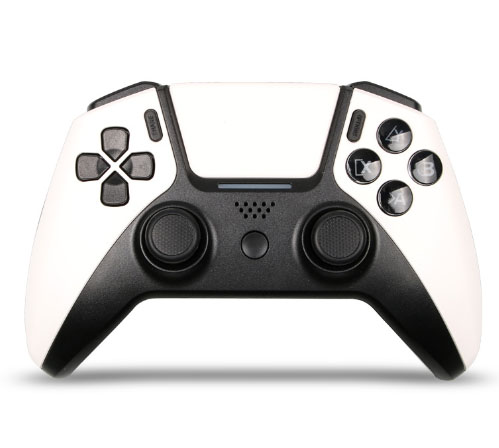
Almost every company that appears in a search for "game controller manufacturer" is a trading company. That is not automatically bad — but you need to know which one you are dealing with before you sign a tooling contract, because the two have completely different failure modes.
Why the word "manufacturer" needs defining
A trading company buys finished controllers from a factory, adds a margin, and resells. A manufacturer owns the assembly line, the test equipment and the engineering staff. Both will show you a catalogue, both will quote you an MOQ, and both will tell you they can customise. The difference appears later:
- A trading company cannot change the firmware, the stick module or the shell material, because it does not make those decisions.
- A trading company cannot tell you the true lead time, because it is quoting someone else's production queue.
- When a defect batch appears, a trading company has to negotiate with its own supplier before it can answer you — and that conversation takes as long as it takes.
For a stock product with your logo printed on the box, a good trading company is fine. For anything with tooling, firmware changes or a warranty commitment, you want the factory.
What a real controller factory must own
Controllers are a higher-barrier product than most accessories. A genuine manufacturer should have all six of these in-house or under direct control:
- SMT and assembly lines for the mainboard and the radio module.
- Stick and trigger module assembly, including calibration — this is where drift is born or prevented.
- Firmware development, or a long-term engineering partner under NDA who works only through them.
- In-line functional test with per-unit calibration logging, not a spot check at the end.
- Ageing and reliability benches — stick rotation rigs, button actuation counters, battery charge-cycle equipment.
- Tooling capability — either moulds in-house or a dedicated tool shop they control, so a shell revision is days rather than months.
Ask which of these are on site. A factory that owns four and outsources two is normal. A supplier that owns none is a trading company.
The vetting sequence, in order
- Business licence check. Look at the registered business scope. If it reads trading, import/export or technology, ask when a manufacturing line was added. A scope that gained manufacturing recently is usually aspirational rather than operational.
- Factory address. Get a specific street address, not a district. Then cross-check it — a single industrial building shared by forty "manufacturers" is a tell.
- Live video tour. Insist on a real-time walkthrough, not a photo album. Ask them to walk from the SMT line to the calibration station to the packing line without cuts. Ask the camera operator two questions that only someone on the floor can answer.
- Test equipment list. Ask for the make and model of their stick calibration rig and their button life tester. A real factory can answer in one message; a trading company will deflect.
- Engineering headcount. Ask how many firmware and hardware engineers they employ directly, and what the last firmware version they shipped included.
- Reference customers. Ask for two brands they have manufactured for, with permission to speak to them. Many will say no for confidentiality reasons — but the way they say no is informative.
- Certification reports. Ask for the FCC ID and the CE test report numbers on a current model, then look up the FCC ID in the public database. If the grantee name is not your supplier, ask why.
- A production-line sample. Not a stock sample from the showroom. Ask for a unit taken from the current production run, with the batch number.
Questions that expose a trading company
These are hard to fake, and a real manufacturer answers them without hesitating:
- What is the model number and supplier of the stick module you use, and has it changed in the last 12 months?
- Which MCU is on the board, and what is the wireless polling rate at the chip level?
- How do you calibrate the stick centre point, and what residual error do you accept?
- What is the cycle life rating of your trigger switch, and who tests it?
- Can you send me the firmware changelog for the last three versions?
- Who owns the mould for this shell, and where is it stored?
- If I want a shell colour change, how many days from approval to first part?
Anyone who made the product can answer most of these from memory. Anyone who resells it will offer to "check with the factory" and come back with something vague.
Protecting your tooling and your IP
Three documents, signed before money moves:
- Mutual NDA covering your artwork, packaging design, firmware configuration and customer list. Be specific about what is confidential — a generic NDA is hard to enforce.
- Tooling ownership clause naming you as the owner of any mould or fixture you pay for, with a stated buy-back price if you leave, and an obligation to store it safely and not use it for anyone else.
- Exclusivity term if you are paying for development. Specify the model code, the markets and the duration. Exclusive on the artwork but not the platform is a common and reasonable compromise.
Also register your brand in the markets you sell in, and keep the retail packaging artwork on your side. A supplier who holds your only copy of the packaging dieline has leverage you did not intend to give them.
Red flags worth walking away from
- Price far below the market with no explanation of where the cost was removed.
- Refusal of any live video tour, for any reason.
- No FCC ID or test report numbers, only screenshots of certificates.
- MOQ "negotiable to any quantity" — means they will buy from whoever is cheapest that week.
- Stock sample offered as a production sample.
- Pressure to pay the full amount up front on a first order.
- Different bank account name from the company name on the PI.
How STEP COOL works
We are a Shenzhen-based manufacturer, established in 2004, with our own assembly and calibration lines, in-house firmware engineering, and reliability benches for stick rotation and button actuation testing. Our current platforms include the SC-Q34U with dual TMR sticks and 1,000 Hz wired and wireless polling, and our PS4, Switch and Xbox controller ranges.
We are happy to give a live factory tour, share FCC and CE report numbers for verification, and send production-line samples. If you are vetting suppliers, send us the same questions you are sending everyone else and compare the answers.