
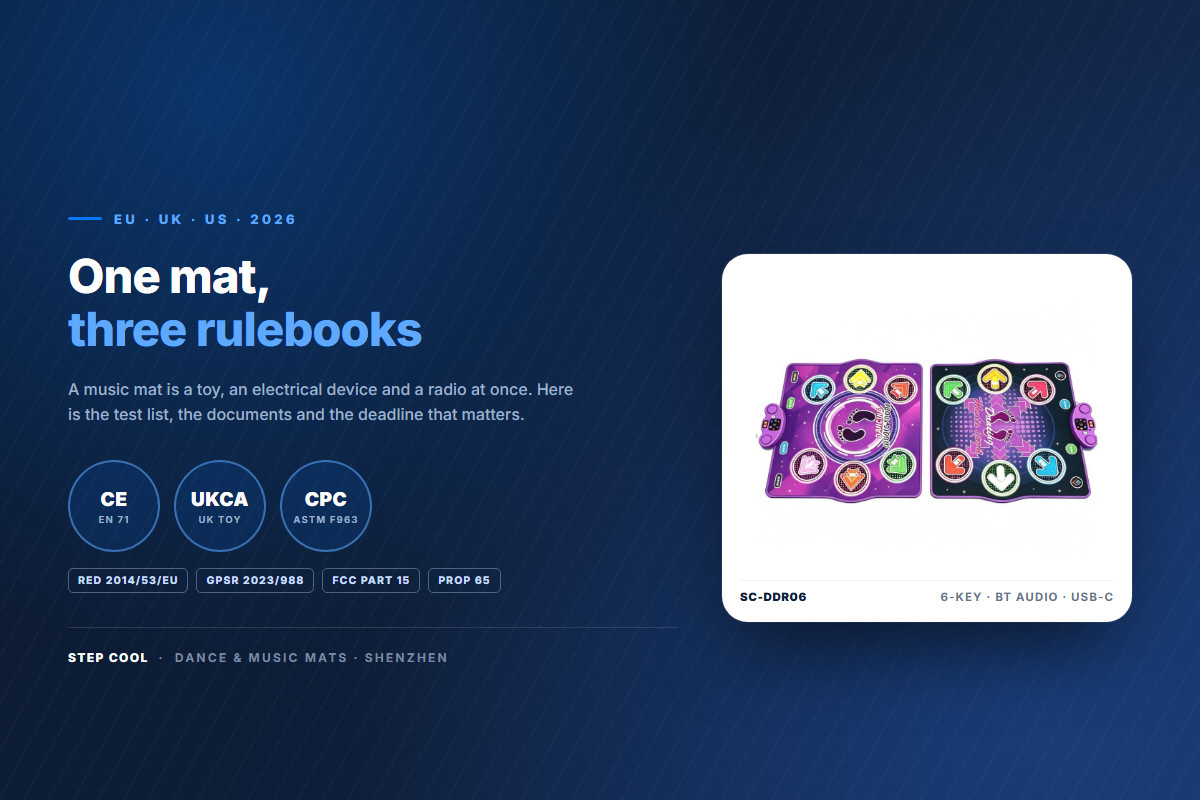
A musical mat is three regulated products in one carton: a toy for a child under 14, an electrical device with an amplifier, a speaker and usually a rechargeable cell, and — if it streams audio — a radio transmitter. Each of those has its own rulebook, its own test house and its own failure mode at customs. The strictest one sets your development pace.
This is the working map we use with buyers. It is written for sourcing and product teams rather than lawyers, and it reflects the position in late 2026, including the EU toy rules that are already published but not yet applicable.
1. Three rulebooks, one product
| Rulebook | EU | US | What failure costs you |
|---|---|---|---|
| Toy safety | EN 71-1/-2/-3, EN 62115 for electric toys | ASTM F963-23 under 16 CFR 1250 | Listing removal, recall, border seizure |
| Chemicals | REACH SVHC and Annex XVII, RoHS | CPSIA lead and phthalates | Detention, mandatory rework, landfill |
| Electrical safety | LVD where mains-powered, EN 62115 for toys | 16 CFR 1505, UL or ETL listing for retail | Retail buyer rejects the SKU |
| Radio and EMC | RED 2014/53/EU, EMC 2014/30/EU | FCC Part 15 certification with FCC ID | Customs hold, platform delisting |
| Batteries and transport | Battery Regulation (EU) 2023/1542, UN 38.3 | UN 38.3, IATA air rules | Airline refuses the shipment |
| Traceability | GPSR (EU) 2023/988 with an EU responsible person | CPSIA permanent tracking label | Marketplace blocks the listing |
The pattern to internalise: toy compliance gets you a certificate, but traceability and radio compliance are what actually stop a shipment at the border or a listing at upload.
2. EU: where the law stands in 2026, and the 2030 deadline
Two dates matter and they are easy to confuse.
Today's route. Products placed on the EU market now are certified against the Toy Safety Directive 2009/48/EC: EN 71-1 for mechanical and physical properties, EN 71-2 for flammability, EN 71-3 for migration of 19 elements, EN 62115 for electric toys, plus EMC and — for anything with Bluetooth — the Radio Equipment Directive. You issue a Declaration of Conformity, affix CE, and hold the technical file.
The 2030 route. The Toy Safety Regulation (EU) 2025/2509 was published on 12 December 2025, entered into force on 1 January 2026 and applies from 1 August 2030, when it repeals the Directive. A unit shipped in 2027 still certifies to the Directive, so there is no immediate re-test obligation. But the Regulation changes what materials you can specify, and materials are decided years before the shipment:
- PFAS restrictions across toy materials, which reaches water-repellent and stain-resistant coatings on mat surfaces.
- Bisphenols restricted as a group, with bisphenol A migration tightened from 0.04 to 0.005 mg/L.
- Lead and cadmium migration limits cut to 2.0 mg/kg and 1.3 mg/kg — roughly half the previous values.
- Formaldehyde emission tightened to 0.062 mg/m³, aligned with REACH Annex XVII entry 77.
- A digital product passport, phased in with the ESPR framework, which means batch-level data has to exist in a system rather than in an email.
Practical advice: keep today's test reports for today's shipments, and add a PFAS and bisphenol question to your next sampling round. If your mat surface relies on a stain-repellent finish, start the substitution conversation now — that is a 12-to-18-month materials project, not a labelling fix.
EN 71-1 itself has been revised. The 2026 edition restructures the acoustic requirements around exposure categories measured at 50 cm and tightens several mechanical clauses. If your report references EN 71-1:2014+A1:2018, ask the lab whether a gap assessment against the new edition is needed for your market — most notified bodies will answer that question in a short call.
3. The EU requirements that are not on the certificate
Three obligations now sit alongside CE and catch importers who only bought test reports.
GPSR. The General Product Safety Regulation (EU) 2023/988 has applied since 13 December 2024. Every product needs an economic operator established in the EU. For an online listing, Article 19 requires the offer itself to show the manufacturer's name and postal and electronic address, the EU responsible person's details where the manufacturer is outside the EU, information identifying the product including an image, and any warnings in a language consumers understand. Marketplaces enforce this through listing fields — no responsible person, no publication.
Battery Regulation (EU) 2023/1542. Applies to the cell inside the mat: marking, documentation, and eventually removability and recycled-content rules. A sealed pouch cell is the wrong long-term choice for a toy.
WEEE and packaging EPR. Electronic toys carry WEEE registration in most member states, and packaging carries extended producer responsibility fees, which in France, Italy and Spain are increasingly collected automatically by marketplaces. Budget these as a per-unit cost, because they are.
4. US: CPC, ASTM F963-23, FCC and Prop 65
The US route is document-driven and the document is not issued by a lab.
- CPC. A Children's Product Certificate is drafted and signed by the US importer or the domestic manufacturer, based on a passing report from a CPSC-accepted, ISO 17025 lab. A factory cannot issue one on its own behalf for the US market — the importer certifies.
- ASTM F963-23 is mandatory through 16 CFR 1250, in force since 20 April 2024. It covers mechanical hazards, flammability, eight soluble heavy metals, and electrical safety for battery toys, including the newer rechargeable lithium requirements. Reports to the older F963-17 are not accepted.
- CPSIA chemistry. Lead at 90 ppm in surface coatings and 100 ppm in substrate; eight phthalates at 0.1% each. In 2026 the marketplaces routinely ask for eight-phthalate reports, and a six-phthalate report may fail review even though it was once standard.
- FCC. Bluetooth audio means a radio transmitter, so Part 15 certification with an FCC ID applies — self-declaration is not enough. Budget the filing as part of the electronics NRE.
- Tracking label. Permanent marking on the product and the packaging with manufacturer or importer, production location, production date and batch. A sticker applied at the warehouse does not satisfy this if it can be removed.
- Prop 65. California requires a clear and reasonable warning for listed chemicals unless exposure is below the applicable threshold. For a music mat the practical candidates are lead in solder and PVC, and phthalates in soft PVC. Decide the route before the artwork is printed, because a warning label is a packaging change, not an afterthought.
5. UK, Canada, Australia and the Gulf
| Market | Toy requirement | Electrical / radio | Note |
|---|---|---|---|
| United Kingdom | UK toy regulations, UKCA marking | UKCA for radio and EMC; UK REACH | CE is not accepted indefinitely; a UK responsible person is expected |
| Canada | Toys Regulations SOR/2011-17 | ISED certification for Bluetooth | Bilingual labelling in English and French |
| Australia / NZ | AS/NZS ISO 8124 | RCM marking | Button-cell safety is enforced separately |
| Gulf states | GCC toy scheme, SASO in Saudi Arabia | Country-specific type approval | Arabic labelling usually required |
Do not assume the EU file travels. Each market above needs its own certificate holder, its own label artwork and, in several cases, its own sample set. Build a market-by-market matrix into the project plan before you commit to a launch date.
6. Where musical mats actually fail in the lab
- Sound pressure at maximum volume. Amplifier clipping raises the C-weighted peak. Fix with a limiter and 5 dB of design margin.
- Small parts. Key caps, LED lenses, battery-cover screws and decorative clips. Fix with one-piece moulding and captive screws.
- Battery compartment. Must require a tool to open, and a coin cell must not be reachable. This is the single most common cause of a failed sample in our experience.
- Surface flammability. Flannel without a back-coating burns too fast for EN 71-2. Specify the coating, not just the fabric weight.
- Phthalates and lead in the print. Testing the raw fabric is not enough — the ink and the printed surface carry the risk.
- Cords and straps. A carry handle or wrist strap becomes a strangulation hazard above the permitted loop length for the age band.
- Optical radiation from LEDs. EN 62115 covers brightness and blue-light exposure; a diffuser is usually the fix.
- Labelling. CE size and placement, age warning, importer and responsible-person address, batch code, and a manual in the right language. Buyers reject perfectly functional products over this.
7. The document set retail buyers ask for
| Document | Issued by | What buyers check |
|---|---|---|
| EN 71-1/-2/-3 report | Accredited lab | Report number, sample description, standard year |
| EN 62115 report | Accredited lab | Battery type and charger match the product |
| EMC / RED test report + EU-type examination | Notified body | Radio profile matches the actual module |
| RoHS and REACH SVHC declaration | Supplier + lab | Full material declaration, not a generic statement |
| EU Declaration of Conformity | Manufacturer or importer | Signed, dated, lists the directives and standards |
| CPC + ASTM F963-23 report | Importer + CPSC-accepted lab | Report date after the last BOM change |
| FCC grant with FCC ID | Telecom certification body | FCC ID printed on the product |
| UN 38.3 + MSDS | Cell or pack supplier | Cell model matches the BOM |
| GPSR responsible-person letter | EU operator | Name, postal address, email, mandate in writing |
8. Budget and lead time
Indicative figures for one SKU, one market, in 2026 — lab-dependent, and cheaper when bundled:
| Scope | Lead time | Indicative budget |
|---|---|---|
| EN 71-1/-2/-3 + EN 62115 (EU toy + electric) | 7–12 working days | US$900–2,000 |
| EMC + RED (Bluetooth audio) | 10–15 working days | US$1,200–2,500 |
| RoHS + REACH SVHC screening | 5–7 working days | US$300–800 |
| CPSIA + ASTM F963-23 (CPC basis) | 7–10 working days | US$800–1,800 |
| FCC Part 15 certification | 2–4 weeks | US$1,500–3,000 |
| UN 38.3 transport test | 2–3 weeks | US$1,000–2,500 |
| Prop 65 screening (lead, phthalates) | 5–7 working days | US$250–600 |
Treat this as product development cost, not overhead. A mat that needs a second round because the print failed phthalates costs the lab fee twice plus four weeks of selling season.
9. Keeping the file valid across batches
Certificates describe a product, not a factory output. They go stale quietly:
- Change control. Any change to ink, fabric supplier, cell model, speaker, radio module or PCB layout is a re-test trigger. Write the list into the supply agreement and require written notice.
- Golden sample. One signed unit held by each side, referenced in the PO. It is the only defence against a silent component substitution.
- Record retention. CPSIA expects five years of test records and the CPC; the GPSR expects technical documentation for ten. Assume the longer period.
- Listing data. Keep the marketplace fields — responsible person, manufacturer address, warnings, label photo — in one document with the packaging artwork, so a platform update does not become a scramble.
Where STEP COOL fits
We have shipped kids' electronic play products into EU, UK, US and Australian retail since 2004, and we build the test programme into the project rather than quoting it afterwards. For the SC-DDR06 music mat and the wider dance mat range, we hold the EN 71, EN 62115, EMC and RoHS files, can supply CPSIA and ASTM F963 reports from a CPSC-accepted lab, and prepare the label artwork with your importer and responsible-person details.
Tell us the markets and the channel, and we will send the document list for each, the current report numbers, and the re-test triggers that would apply to your customisation.