
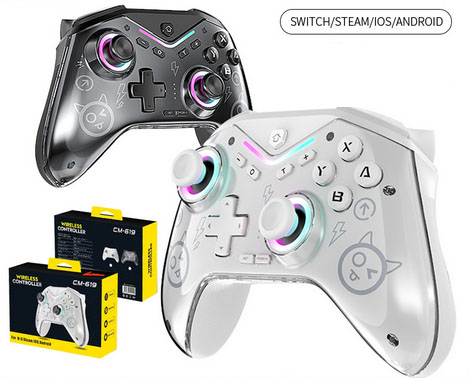
Wired or wireless looks like a spec-sheet footnote and turns out to be a business-model decision. The connection type drives your battery-related return rate, your certification scope, your freight weight and which retail channel the product can even be listed in. Buying the wrong mix for your channel is one of the quietest ways distributors lose margin.
This guide compares the three connection types as a wholesale buyer sees them — not as an engineer does. For stick technology specifically, read Hall effect vs TMR sticks; for a channel-price view of the category, see wholesale game controllers.
1. The three connection types
- Wired USB. Power and data over one cable. No battery, no pairing, no radio certification. The cheapest to build, the lightest to certify, and the most reliable thing you can hand a customer.
- Bluetooth. Pairs directly with consoles, phones, tablets, PCs and the Switch. No dongle to lose. Radio certification applies (RED in the EU, FCC Part 15 in the US), and a lithium cell is usually onboard — which adds UN38.3 to the shipping path.
- 2.4G via USB dongle. A dedicated radio link with lower latency than Bluetooth and rock-solid pairing on consoles and PCs — but the dongle is a tiny, losable, warranty-magnet component, and the radio certification burden is the same as Bluetooth.
- Hybrid (tri-mode) controllers combine all three: wired for play-and-charge, Bluetooth for mobile, 2.4G for console. They dominate the mid-to-premium OEM market because one SKU covers every screen the customer owns.
2. Latency claims versus living-room reality
Wired remains the latency reference, and 2.4G dongles are close behind on a clean channel. Bluetooth adds a few to tens of milliseconds depending on the implementation and the host device. In practice, for the family, casual and mobile segments that make up most wholesale volume, customers cannot reliably feel the difference between a good Bluetooth implementation and a cable. Latency becomes a purchase criterion in competitive and esports contexts — which is exactly the segment where wired or 2.4G should lead your range.
The wholesale-relevant point: Bluetooth's latency varies more across host devices than across controllers. A controller that feels perfect on a Switch may feel laggy on a budget Android tablet. If your listings target mobile gamers, firmware-side tuning per platform matters more than the radio spec sheet.
3. Warranty and returns exposure
- Battery is the number-one wireless failure item. Capacity fade, charge-port wear and swelling drive most year-one warranty claims on wireless controllers. A wired controller has none.
- The dongle is the number-two item on 2.4G products — lost, broken in the USB port, or left behind in another device. Spares policy matters: ask whether replacement dongles can be shipped individually and whether the pairing is re-bindable in the field.
- Pairing complaints are self-inflicted if untested. Each platform pairing flow (Switch, PS4, Android, iOS, PC X-Input) must be tested against real host devices, not assumed from the chip vendor's datasheet.
- Cable strain relief is the wired controller's only significant failure point — specify the pull test and the bend radius in the acceptance criteria.
Channel mix guidance: for marketplace and family retail, expect wireless to outsell wired three to one on the shelf despite the returns profile — the cable is a perceived downgrade. For esports, VR-adjacent and budget multi-pack channels, wired wins on price reliability and zero battery risk.
4. Which connection fits which channel
| Channel / customer | Recommended mix | Why |
|---|---|---|
| Online marketplaces (Amazon etc.) | Tri-mode wireless as hero SKU, wired as price anchor | Wireless converts on the listing; wired defends the price ladder |
| Family / toy retail | Wireless TV-style and Bluetooth pads | No cable across the living room; parents value it |
| Distributor / B2B multi-packs | Wired multi-packs | Lowest unit cost, no battery logistics, minimal warranty load |
| Esports / enthusiast | 2.4G + wired, Hall/TMR sticks | Latency and reliability are the product |
| Mobile-first (phones, tablets) | Bluetooth with telescopic or clip designs | Direct pairing, no dongle on the go |
5. Pricing and margin structure
Expect wireless variants to carry a meaningful FOB premium over wired equivalents — battery, radio module, dongle and the certification behind them are real BOM and compliance costs, typically adding a third to half again to the wired price at similar volumes. The margin question is therefore not "wireless or wired" but "what does my channel pay for the wireless premium". Marketplace and family retail pays it comfortably. Multi-pack B2B channels rarely do.
Freight is a second, quieter factor: batteries add air-freight declarations (UN38.3) and sometimes push shipments to sea freight, adding lead time. Wired controllers ship like any other plastic accessory. If your replenishment cadence depends on air freight, the wireless premium is bigger than the FOB delta suggests — model the full picture with the landed cost calculator.
Where STEP COOL sits on the wired/wireless map
We manufacture across the full spectrum, which lets buyers build a coherent ladder from one factory: tri-mode controllers like the SC-Q34U (wired / Bluetooth / 2.4G, PC / Switch / PS4 / Android / iOS), Bluetooth lines for Switch and mobile (SC-NS016, SC-Q11), wired console controllers for the Xbox and PS ranges (SC-XB018, SC-P4025), plus wired 4-in-1 dance mats and wireless TV mat systems.
Tell us your channel and price ladder — we will recommend the connection mix per tier and quote the certification set each option needs for your market.