
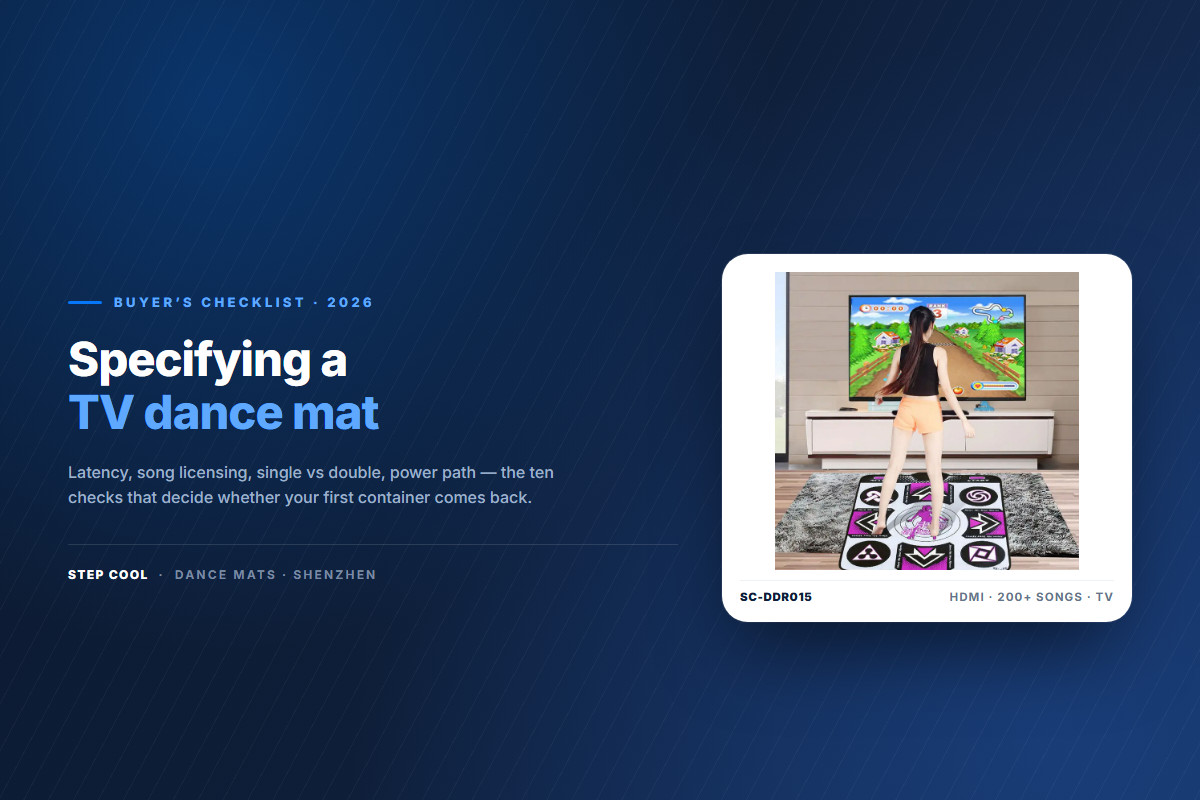
A TV dance mat looks like a simple product: a mat, a box and an HDMI cable. It is not. Two mats that photograph identically can differ by 200 ms of input lag, by whether their 200 songs are licensed, or by a sensor layer that creases and dies in month four. This is the checklist we use when a buyer asks for a TV mat quote — written so you can run it against any supplier, including us.
1. What you are actually buying
A plug-and-play TV dance mat is three subsystems in one carton, and most sourcing mistakes happen at the seams between them.
- The mat — a sensor sandwich: printed top sheet, spacer, conductive circuit sheet, and a base with anti-slip backing. Four, six or eight step zones.
- The console box — decoder board, game firmware with the song library, and the video output stage. Usually a low-cost ARM SoC with 128 MB to 512 MB of flash.
- The interface — HDMI (current standard), composite RCA (legacy), or a 2.4 GHz wireless receiver that plugs into the TV.
A good mat with a slow decoder feels broken to the player. A fast decoder with a creasing sensor layer generates returns in the fourth month, after your first container has already sold through. Both problems are visible on a sample if you know what to measure.
2. Video output and input latency
Ask for the resolution and the frame path, not just “HDMI”. 720p is the volume standard because it keeps the SoC, the memory bandwidth and the retail price in the range mass retail buys at. 1080p is worth paying for only if your channel is a brand that sells on picture quality — it adds cost at the SoC, at the flash and often at the power supply.
More important than resolution is end-to-end latency: the time from foot contact to the arrow lighting up. Ask the factory to measure it, then verify yourself. The practical test needs no lab equipment:
- Set a phone to 240 fps and frame the TV and the mat edge in one shot.
- Step on an arrow and count the frames between the foot landing and the on-screen response.
- Divide by 240. Thirty-six frames is 150 ms.
Under 100 ms feels instant. Around 150 ms is tolerable for casual family play. Above 200 ms players stop blaming themselves and start blaming the product — and that shows up in reviews, not in your inspection report.
Legacy RCA output still matters in markets with older TV stock, in hospitality and in some Latin American and Southeast Asian channels. If you need both outputs, insist on a SoC with native dual output rather than an external HDMI-to-RCA converter: the converter alone can add 30–60 ms.
3. The song library is a licensing question, not a storage question
Buyers compare song counts — 100, 200, 800 — because it is the only number on the box that looks like value. What actually matters is where those tracks come from.
There are three legitimate sources, and they carry different risks:
| Source | What it means commercially | Watch out for |
|---|---|---|
| Original compositions | Written for the product; no per-unit royalty | Often generic-sounding; ask who owns the master |
| Licensed covers | Recognisable melodies, paid per unit or per territory | Territory limits — a licence for EU does not cover the US |
| Public-domain arrangements | No royalty on the composition | The recording may still be protected |
When a supplier quotes “200 built-in songs”, ask for the list and the licence basis in writing. If the answer is vague, the tracks were almost certainly pulled from a consumer music site, and the exposure lands on the brand on the box — you, not the factory.
The workaround most private-label programmes use is MP3 loading: ship 20–40 original tracks, and let the customer add their own music from a USB stick or microSD card. This shifts the licensing question to the end user, which is accepted practice, but the manual has to say so clearly and the file support has to actually work (FAT32, MP3 up to 320 kbps, no DRM files).
4. Single pad or double pad
The mat size decision is a freight decision as much as a gameplay decision. A double pad roughly doubles carton volume, and on a 40 HQ container that can raise freight per unit by 60–80% — enough to erase the unit-price advantage of the cheaper mat.
| Single (4–6 zone) | Double (2-player) | |
|---|---|---|
| Mat size (typical) | 90 × 80 cm | 160 × 80 cm |
| Play modes | Solo, challenge, memory | Solo plus versus and co-op |
| Carton cube | ~0.035 m³ | ~0.065–0.075 m³ |
| Best channel | Value retail, e-commerce, gifting | Family retail, toy chains, party season |
If you sell both, do not assume the double is simply two singles taped together. The firmware needs separate player inputs, the sensor harness carries twice the channels, and the failure rate of the connector is the single most common field complaint on double pads.
5. Power: AA cells, adapter or USB-C
Three options, three different compliance paths:
- 4×AA cells — cheapest to certify, no battery paperwork, but battery doors, springs and corroded contacts are a steady source of returns.
- DC adapter — needs a certified external power supply for each market (CE, UKCA, UL/ETL, SAA). Buy the PSU from a supplier who already holds those certificates rather than certifying your own.
- USB-C rechargeable — the feature buyers now expect, and the option that adds work: a lithium cell means UN38.3, an MSDS and a Wh rating before anyone will fly it.
If your mat contains lithium, request the UN38.3 test summary, the MSDS and the battery specification sheet before you approve the sample. Air freight will be refused without them, and a sea-only product changes your replenishment maths.
6. The spec sheet to require from every supplier
Send this table and ask for it back filled in. Suppliers who cannot answer are assembling, not manufacturing.
| Video output | HDMI version, resolution, frame rate; RCA if required |
|---|---|
| SoC / memory | Chip family, flash size, whether the firmware is yours or theirs |
| Songs | Count, language mix, licence basis, MP3 loading support |
| Sensor | Membrane, FSR or printed ink; expected life in cycles |
| Zones | Number of step zones and whether diagonal combinations register |
| Mat surface | Material, thickness, anti-slip backing, wipe-clean claim |
| Power | Cells / adapter / USB-C; runtime; charge time |
| Latency | Measured end-to-end figure with the test method |
| Carton | Dimensions, gross weight, units per 40 HQ |
| Documents | CE-RED, LVD, EMC, RoHS, EN 71, FCC, CPC — with report numbers |
7. MOQ, tooling and the cost ladder
Indicative FOB Shenzhen ranges at around 1,000 pieces, which is where most private-label programmes start:
- US$6–9 — 4-zone value mat, AA powered, 30–60 songs, no radio.
- US$11–18 — 6-zone mat, USB-C rechargeable, Bluetooth audio, 100–200 songs.
- US$18–28 — 8-zone or double-player mat, metal-dome or FSR sensors, richer song library.
Tooling is usually zero if you accept an existing housing and mat print. A new housing is a real project — mould cost, structural validation, a new safety evaluation — and should only be attempted when the volume justifies it. For most first orders, the money is better spent on the mat surface print and the packaging than on a new shell.
8. Twelve-point incoming QC
- Weigh and measure the carton against the spec — cube creep is how freight budgets break.
- Power on from cold; time to the menu screen.
- Step every zone 30 times and count misses.
- Test all four diagonal combinations.
- Run a full song at maximum volume; listen for distortion and rattle.
- Pair Bluetooth, walk 8 metres away, check for dropouts.
- Load an MP3 from USB and from microSD; confirm playback and track order.
- Fold and unfold the mat 20 times, then retest all zones.
- Leave it powered for two hours; check for heat at the console box.
- Check the label: model, rating, importer address, age grading, CE mark placement.
- Verify the report numbers on the documents against the certificates themselves.
- Drop-test one carton from 80 cm on a corner, then inspect the mat inside.
9. Documents to demand before the deposit
For the EU you need the Radio Equipment Directive certificate for the 2.4 GHz link, the Low Voltage certificate, an EMC report and RoHS. If the mat is sold to children, add EN 71-1, EN 71-2, EN 71-3 and EN IEC 62115 — a TV dance mat aimed at families is a toy in the eyes of market surveillance. For the US you need an FCC ID and the Part 15.249 report, plus a Children’s Product Certificate if the age grading is under 12.
Do not accept a certificate cover sheet. Ask for the report number, the laboratory and the model list, then check that your model is on it. Our own set is published with numbers at our certifications page, which is also a useful benchmark for what a complete file looks like.
10. What to send us for a quote
If you are evaluating a TV mat programme, the fastest path is a short brief: target market and channel, retail price point, single or double, power preference, song strategy, age grading, packaging style and first-order quantity. With those six answers we can quote a platform that already exists rather than inventing one, which usually saves four to six weeks.
Start from our dance mat range to see the two platforms that cover most requests — the SC-DDR015 single TV mat and the SC-DDR03 double version — or read the compliance map first if your market is the EU.