
A private-mold controller is the fastest way to stop competing on the same housing as every other importer, and the number one reason buyers abandon the idea is an unclear tooling quotation. This guide breaks a custom controller into its cost lines — shell mold, buttons, electronics, certification retests — explains what actually moves each price, and gives you the questions that separate a real factory quote from a padded one.
Private mold versus stock housing
Every controller on a supplier's catalogue sits in one of two categories. A stock housing is an existing mold the factory already owns: you change colors, artwork and maybe the button layout, and you pay nothing for tooling. A private mold (sometimes called a dedicated or exclusive mold) means new part drawings, new molds and a housing nobody else can order. The trade is straightforward: tooling cost and a longer runway in exchange for a product your competitors cannot list.
Most buyers we work with start on a stock platform, validate demand, then move to a private mold for the second generation. That sequencing matters because tooling money spent on an unvalidated design is the most expensive lesson in this industry. If you are unsure which model fits your stage, our comparison of private label, OEM and ODM walks through who owns what in each case.
The five cost lines inside a tooling quotation
A controller quotation with tooling should separate five lines. If your quote merges them into one number, you cannot negotiate, audit or transfer any of them:
| Cost line | What it covers | What drives the price |
|---|---|---|
| Shell molds | Front case, back case, usually the largest single line | Part size, cavity count, steel grade, texture (VDI/MT), slide actions |
| Button tooling | Keycaps, D-pad, triggers, silicone pads | Number of separate parts; silicone tooling is cheap but the parts have their own lifetime |
| Electronics NRE | PCB layout, firmware development, RF tuning, test fixtures | Platform count (Switch, PS, PC each add work), wireless stack, app integration |
| Certification retests | Radio and safety tests run on YOUR housing, not the factory's | Number of radios and target markets; every antenna change means retesting |
| First-article and fixtures | Assembly jigs, end-of-line test rigs, golden samples | How much of the line is already set up for a similar platform |
Two of these lines survive into the unit price. Molds are amortized across the order quantity or paid upfront; NRE is usually paid once. Certification retests are a real budget line that buyers who quote only from Alibaba listing prices always forget.
What actually moves the shell mold price
The shell is where quotations diverge most, and the driver is almost never the outer shape:
- Cavity count. A single-cavity mold produces one shell per cycle; a family mold produces front and back in one tool. Fewer cavities means cheaper tooling but a slower, costlier production run — the trade-off belongs in your landed-cost math, not just the tooling quote. The landed cost calculator handles the freight and duty side once you have a unit price.
- Steel grade and hardness. P20 steel is the default for mid-volume plastics; hardened steels cost more per tool but survive millions of shots. If your program runs multiple years, the hardened option is usually cheaper per unit over its life.
- Texture. An etched texture (grained finish on the grip) adds a tooling step and a recurring cost when the texture plate wears. Rubberized paint looks premium in photos and fails in cartons — ask for the scratch test result, not the render.
- Actions. Slides and lifters are needed wherever the housing has undercuts — speaker grilles, USB-C ports, trigger wells. Every action adds cost and a future maintenance item.
Absolutely require a 3D CAD review before any mold steel is cut. Changes after cutting are charged at rework rates and eat weeks; changes on the drawing cost a conversation.
Buttons, silicone and the parts people forget
The housing gets all the attention, but the tactile parts carry the tooling too. Keycaps and D-pads are molded parts; the silicone contact pads under them are cheap to tool but determine how the buttons feel after 500,000 presses. Two things worth specifying explicitly:
- Silicone actuation force and travel. This is a feel decision, not a cost decision. Ask for sample boards at two force ratings and choose with your hands; a spec written as "standard" will drift between production runs.
- Part consolidation. Every extra molded part is another tool, another color approval and another item in the assembly sequence. A designer who merges two parts into one saves tooling cost twice — once at the mold and once at the line.
Button feel and durability are the same conversation as stick wear, which we cover separately in our guide to stick drift causes and factory fixes; the acceptance logic is identical.
Electronics NRE: the invisible half of the budget
Molds make the controller look like yours; the electronics NRE makes it work like yours. Typical NRE scope for a wireless multi-platform controller includes PCB layout, firmware bring-up, RF antenna tuning in the new housing, and production test fixtures. Each additional platform multiplies the firmware and testing work, which is why a PC-only build is the cheapest to develop and a PC / Switch / PS4 build costs meaningfully more — and why the platforms you actually sell in should be the only ones in the spec.
If you plan a companion app, decide its scope before quoting. Our firmware customization guide breaks down what remapping, macros and app integration each add to the development effort, and which parts are worth paying for on a first generation.
Certification retests on your housing
This is the line most first-time buyers miss. A factory's published certificates — CE-RED, LVD, EMC, FCC, RoHS — were issued on their reference housing. Your new shell is a new enclosure around the same radio, and the radio's performance depends on the enclosure. Depending on the change and the market, you are looking at retesting the radio in the new housing and, for some programs, resubmitting documentation. Budget for it and schedule it: certification runs in parallel with tooling only if you planned the samples early. Our certifications page lists the reports we maintain across platforms, which is the baseline every retest starts from.
A realistic timeline, end to end
Tooling schedules fail on review loops, not on mold cutting. A realistic sequence looks like this:
- Weeks 0–2: industrial design and structure drawings frozen; quotation finalized against the frozen drawings.
- Weeks 2–4: DFM (design for manufacturing) review with the mold maker; changes here are cheap. Mold cutting starts.
- Weeks 4–10: mold cutting and first shots (T1). Expect T1 samples to need revisions — texture, fit, gate marks. Plan two revision loops, not zero.
- In parallel: electronics NRE, firmware builds on the new PCB, RF tuning in the new housing, certification samples submitted early.
- After approval: pilot run, then mass production in our standard 25–35 day window, with samples available within 5–7 days of a frozen design for reference builds.
The honest total for a first private-mold controller is a couple of months of development before the production clock starts. Suppliers who promise mold-plus-production in one compressed window are borrowing time from the revision loops, and you will pay it back in fit-and-finish complaints.
MOQ and how tooling is amortized
Our standard MOQ starts at 1,000 pieces per model, and tooling is quoted either as a one-time fee or amortized into the unit price over an agreed quantity. Amortization sounds friendlier and usually costs more: you pay it whether the tool is used or not, and it complicates reorders. If cash flow allows, paying tooling upfront and keeping the unit price clean is almost always the cheaper structure over a two-order horizon. Model both cases with your real quantities before signing — the calculator handles the per-unit view either way.
Tooling ownership and the exit clause
One question decides whether your mold is an asset or a hostage: who owns the steel? Insist on three things in the contract:
- Ownership named in writing — the tooling invoice is paid by you and the tool is tagged as your property in the factory's asset list.
- Free movement — if you move production, the factory releases the molds within an agreed number of days, at your cost of shipping only.
- Maintenance duty — the factory maintains the molds at its cost during production; a mold returned full of rust or missing actions is worthless.
The same logic applies to firmware source and test fixtures. Anything you paid NRE for should be deliverable to you or your next factory without renegotiation.
How we quote tooling at Stepcool
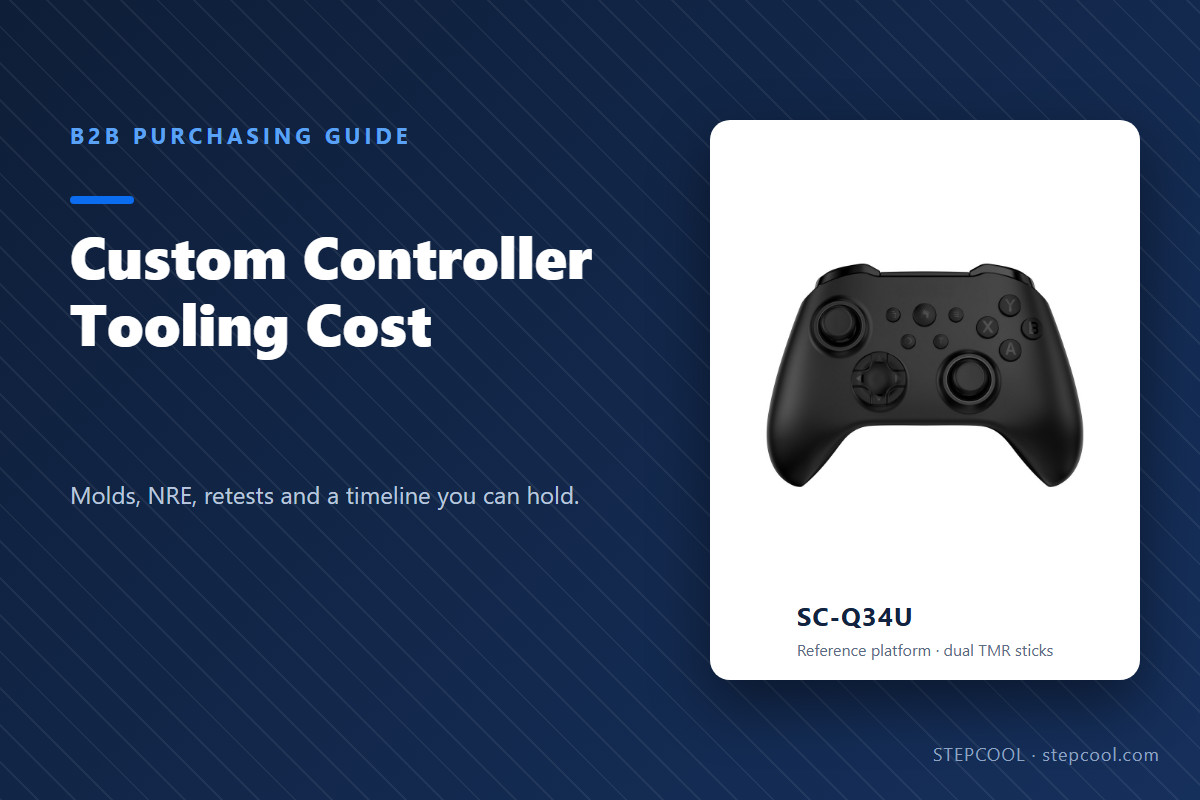
We have been manufacturing in Shenzhen Baoan since 2004, with production bases in Fuhai and Songgang and in-house tooling and firmware engineering. A tooling quotation from us lists the five cost lines above separately, includes the DFM review before steel cutting, and names tooling ownership in the order contract. Reference platforms you can hold today: the SC-Q34U with dual TMR sticks and 1,000 Hz polling, and the SC-NS016 programmable Switch controller — both show what a finished custom platform feels like before you commit to your own mold. Our dance mat tooling guide covers the same economics for the soft-mat category.
If you have drawings or even a reference product, send them through the quote form with your target platforms and quantities; you will get a separated quotation and a revision-loop schedule you can hold us to.