
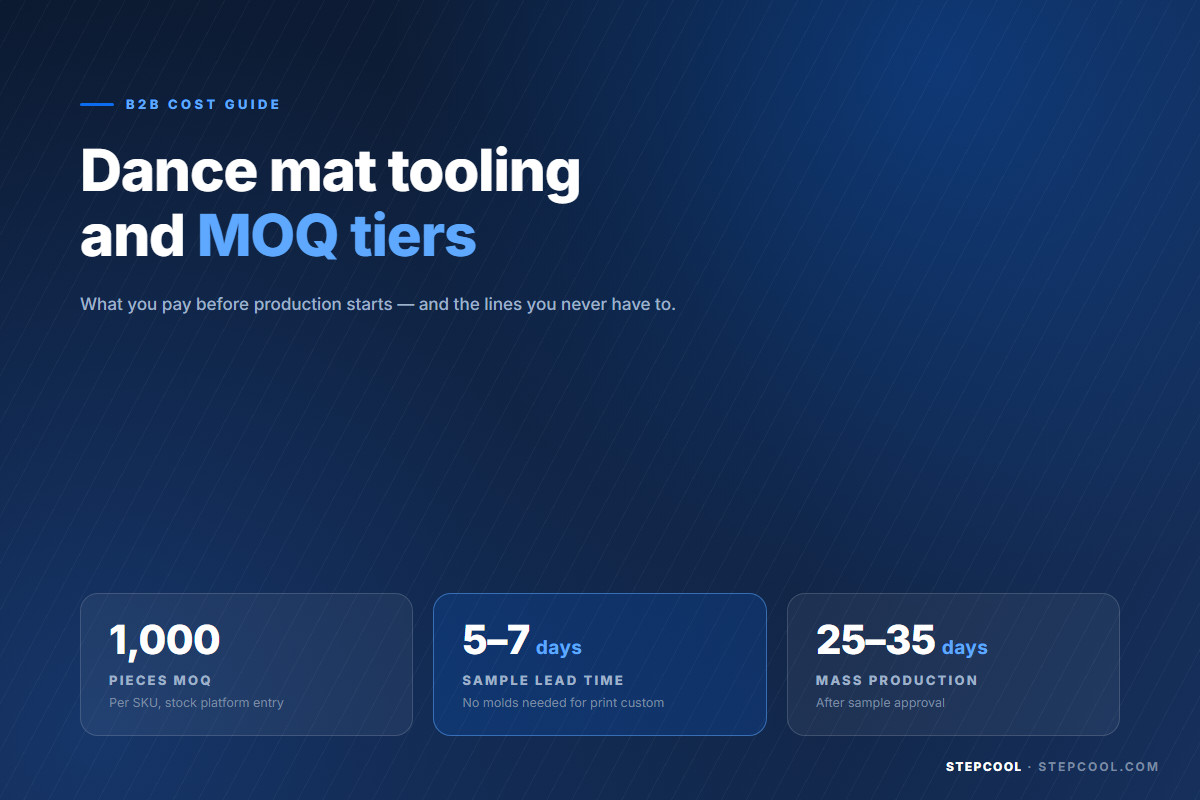
A soft dance mat is not an injection-molded product, yet buyers routinely budget for a mold they will never need. Most of what you actually sell — print, size, sensor layout, song list, packaging — carries little or no tooling cost, and the expensive steel only enters the project when you also customize the plastic around the mat. This guide splits the cost lines apart and shows what changes at each MOQ tier.
This guide pairs with two earlier ones: how MOQ is actually calculated and how sensor construction drives cost.
1. What counts as tooling on a soft product
On a typical fabric or PEVA dance mat, "tooling" is a set of small, mostly reusable fixtures rather than steel molds:
| Item | What it produces | Indicative cost | Reuse |
|---|---|---|---|
| Silkscreen frame | One print colour on the mat surface | US$20–60 per colour | Reused every order while the design runs |
| Die-cut punch | Mat outline, sensor layer cut-outs, foam inserts | US$150–500 | Reused |
| Welding and sewing jigs | Edge welds, hem shapes, anti-slip dot patterns | Usually absorbed by the factory | Reused |
| Injection mold — small part | Key caps, LED lenses, adapter shells | US$2,000–6,000 | Owned or amortised — see below |
| Injection mold — housing | Wired controller shell, console-compatible pad frame | US$5,000–15,000 | Same |
The ranges are what we see in South China in 2026 for budgeting; every quote differs with size, parting lines and cavity count. The pattern matters more than the numbers: the soft product itself almost never needs a mold.
2. Where the money actually goes
When buyers compare "custom" against "stock", they often fear the wrong line. On a mat platform that already exists, the cost drivers are:
- Print coverage and colours. Each additional colour adds a screen and slows the line — visible on artwork-heavy licensed-style prints.
- Sensor resolution. More arrows or keys mean more membrane layers and more testing; this is an engineering and yield cost, not tooling.
- Certification per market. A CE-RED, LVD, EMC and RoHS set for the EU, FCC and CPC for the US — see the compliance guide. Certification is per design and per market, and it does not shrink with volume.
- Firmware customisation. Startup logo, song list, difficulty tuning — near-zero tooling, mostly engineering hours.
If a supplier quotes a large "tooling fee" for a print change on an existing platform, ask exactly what is being built. A legitimate answer names a physical item — a screen, a punch, a mold — with a drawing. A vague lump sum is usually margin, not steel.
3. When an injection mold is genuinely worth it
Three situations justify real tooling on this category:
- Console-compatible hard pads. Arcade-style pads with a plastic frame cannot be built without a housing mold; the frame is the product.
- Retail packaging that must stand out. A custom blister or insert tray can lift shelf conversion enough to pay back a small mold over a season.
- Accessory sets. Custom key-cap sets, dance handles or controller housings that extend a mat range into a product family.
The test is arithmetic, not taste: expected volume × margin uplift versus mold cost. At 1,000 pieces almost no mold passes that test. At 5,000–10,000 pieces a housing mold frequently does, especially if it is shared across several SKUs in the range.
4. What changes at each MOQ tier
We run an MOQ of 1,000 pieces per SKU, which is the practical entry point for a customised soft product. What each tier realistically buys:
| Order size | What is realistic | What is not |
|---|---|---|
| 1,000–2,000 pcs | Stock platform, custom surface print, custom colours, your logo on mat and gift box, song list or firmware tweaks | Dedicated molds, exclusive electronics, custom dielines with special finishes |
| 3,000–5,000 pcs | Custom carton dieline, upgraded print with lamination or spot colour, private-label manuals and packaging inserts | Still rarely molds — unless shared across SKUs |
| 5,000–10,000+ pcs | Dedicated plastic parts, exclusive colourways, blister packaging, accessory tooling | Nothing — at this tier most requests are achievable |
Two traps to avoid: spreading a small first order across too many SKUs (each SKU keeps its MOQ, so six "test" colours means 6,000 pieces), and paying tooling before a sample is approved — see the sample discipline in our TV dance mat buying guide.
5. Stock platform versus full custom
The cheapest custom mat is the one that reuses an existing platform: proven electronics, existing tooling, existing test reports for the shared design — with your print, colours and packaging on top. A full custom build (new sensor layout, new controller, new housing) is a different project: expect mold and certification costs together, and schedule them together.
As a middle path, many buyers start with a stock dance mat platform, run a season, and move specific elements — packaging first, then print finish, then plastic parts — into custom as volumes justify. The OEM guide walks through that progression.
6. Where tooling sits in the calendar
| Stage | Typical duration | Notes |
|---|---|---|
| Sample without molds | 5–7 days | Stock platform, custom print proof |
| Sample with new plastic parts | 2–4 weeks | Mold time added serially before you can touch a real sample |
| Mass production | 25–35 days | After sample approval and deposit |
The planning consequence is simple: every mold you add pushes first shipment out by weeks, not days. If your launch window is fixed, decide the tooling scope before you agree the calendar, not after.
7. Who owns the tooling — ask this early
- Ownership or amortisation? If a fee is charged, ask whether it buys ownership (you can move the mold) or amortisation (it stays with the factory and is repaid through volume).
- Reorders. Confirm in writing that repeat orders carry no repeat tooling charge.
- Storage and maintenance. Who pays to keep and service the mold between orders, and what happens after twelve months of silence?
- Escrow by drawing. Even without ownership, keep the part drawings and specifications — a second factory can quote a replacement far faster with them.
None of this is adversarial; factories that intend to keep your business answer all four comfortably.
Where STEP COOL fits
We have manufactured dance mats in Shenzhen since 2004, from two plants in Bao'an (Fuhai and Songgang), with an MOQ of 1,000 pieces, samples in 5–7 days and mass production in 25–35 days. Because we hold both soft-product lines and controller lines, we can quote honestly which parts of your project need tooling and which do not — see the SC-DDR05 as an example of a stock platform that takes custom print and packaging without molds.
Send your target market, quantity and launch window, and we will return a cost line per item — print, electronics, packaging, certification — so you can see exactly what any "tooling fee" is buying. Check the freight impact first with the landed cost calculator, then request a quote or read about our OEM/ODM process.