
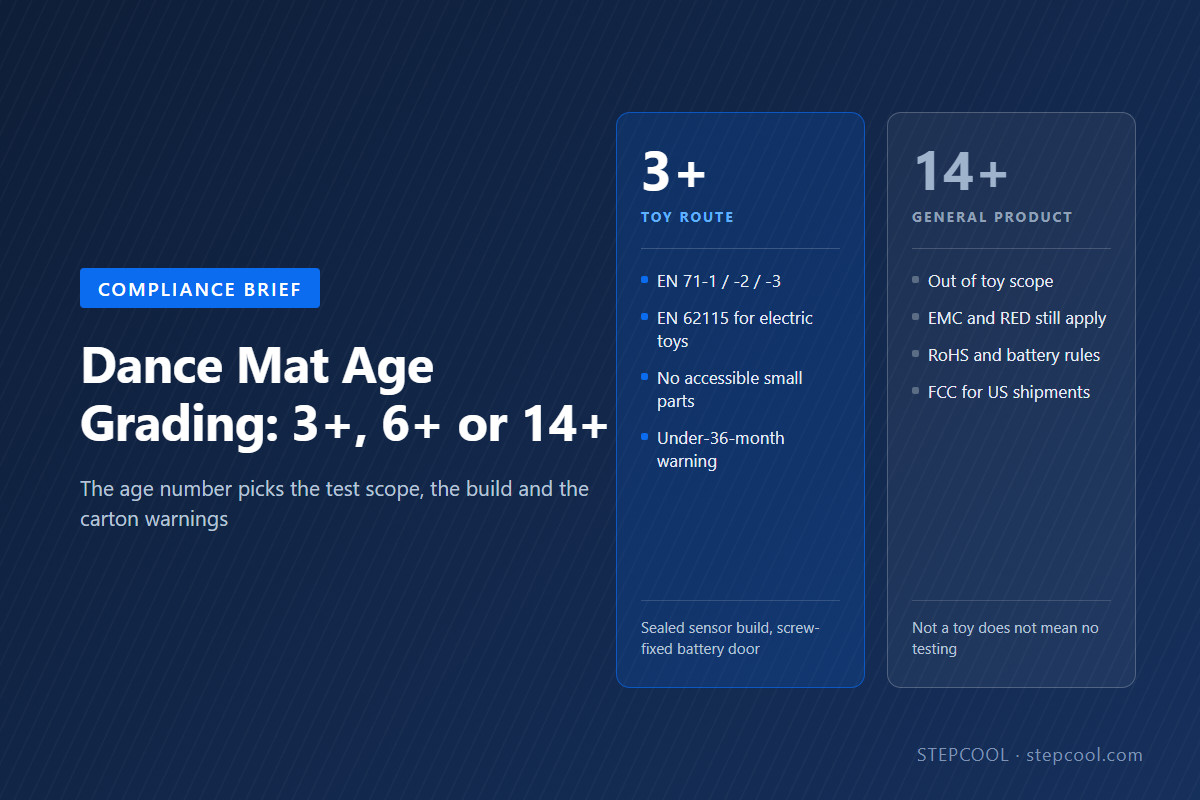
The age number printed on a dance mat carton is not copywriting — it selects the safety regime the product lives under, the test reports a retailer will ask for, and the warnings that must appear on the box and in the manual. Move the number without moving the product and you create a compliance gap that surfaces at exactly the wrong moment: retailer QA, customs, or a marketplace listing review. This guide sets out what 3+, 6+ and 14+ actually commit an importer to, and what has to change in the mat before any of those claims can be defended.
The age mark selects a rulebook, not an audience
In both major markets the age grade does legal work. In the EU, a toy is a product designed or intended for play by children under 14 years; the Toy Safety Directive and its replacement regulation apply below that line. In the US, a children's product is one designed or intended primarily for children 12 years or younger under CPSIA, and that definition triggers third-party testing and a Children's Product Certificate.
Two different thresholds on one product is the single most common source of confusion in this category. A mat marked 13+ sits outside the EU toy scope but is still a children's product in the US. A mat marked 6+ sits inside both. If your range sells into the EU and the US, the age grade has to be chosen against the stricter of the two routes, or the product has to be split into two SKUs with different documentation.
Decide the grade before finalising the bill of materials: it sets the materials, the sealing, the small-part risks and the reports you pay for.
What 3+, 6+ and 14+ mean in practice
| Grade | What the mark promises | Typical mat build | Test scope it pulls in |
|---|---|---|---|
| 3+ | The mat is safe for a child who still mouths objects and has poor balance. No accessible small parts, no long cords, no detachable dongle a child can swallow. | Sealed sensor sandwich, captive battery door with a tool-required screw, short permanently attached cable or wireless receiver in a child-proof housing, thick padding | EN 71-1, EN 71-2, EN 71-3 and EN 62115 in the EU; ASTM F963 plus 16 CFR 1505 for electrically operated toys in the US |
| 6+ | The child handles the product independently. Small parts and cables are permitted, but edges, pinch points and electrical access still have to be controlled. | Detachable wired controller or dongle, thinner mat, larger fold, more exposed connectors and strain relief | Same toy standards, with the small-parts and cord provisions applied at the 6+ level rather than the under-36-month level |
| 14+ | The product is not a toy. It is a consumer electronic fitness/gaming accessory aimed at teenagers and adults. | Heavier duty surface, longer cables, console-grade controllers, no child-oriented artwork or character licensing | Out of toy scope in the EU; in the US, general-use product rules. Electronics directives still apply: EMC, RED for wireless, RoHS, battery rules |
Note what does not disappear at 14+. Dropping out of toy scope removes EN 71 and ASTM F963 testing, not electrical safety, radio compliance or chemical restrictions on the housing and cable. Buyers who read "not a toy" as "no testing" are the ones who get stopped at the port.
What has to change in the mat itself
Grade changes are engineering changes. The five that matter most on a dance mat:
- Sensor sealing. A 3+ mat gets stepped on by a child holding a drink. The sensor film and its overlay need a sealed perimeter and welded or laminated edges, not just an open fabric hem.
- Battery access. For 3+, the compartment needs a screw or a two-action latch that a child cannot open, and the cell itself must sit in a housing that survives being dropped on a corner.
- Cord and connector. Cables for under-6 products should be short, permanently attached and strain-relieved at the exit; a detachable dongle the size of a fingernail is a small-parts problem regardless of what the box says.
- Surface content. Character art, colour palettes and packaging imagery are evidence of intended age. A mat designed for six-year-olds keeps the 6+ obligations even if the box is reprinted for adults.
- Physical size and weight. A 3+ mat has to fold small and light enough for a small child to move, which usually means a thinner build — and a thinner build changes the drop and step test results.
Each of these sits in the sample and tooling stage. Retrofitting them after tooling is the expensive version of the same conversation, which is why our tooling and MOQ guide puts the age grade in the same decision block as the mould.
EU: EN 71, CE and the regulation change
The framework in force for shipments today is the Toy Safety Directive 2009/48/EC, supported by the EN 71 series: EN 71-1 for mechanical and physical properties, EN 71-2 for flammability, EN 71-3 for migration of certain elements. An electric dance mat adds EN 62115 for electric toys. The CE mark, an EU declaration of conformity and a technical file sit on top.
Two dates matter for planning. First, the General Product Safety Regulation (EU) 2023/988 has applied since 13 December 2024, and it requires a named EU responsible person, batch-level traceability and warnings in the language of the member state of sale — obligations that sit alongside the toy rules rather than replacing them. Second, the new Toy Safety Regulation (EU) 2025/2509 entered into force on 1 January 2026 and applies from 1 August 2030, tightening chemical requirements and traceability for toys. Shipments placed on the market before that date are governed by the directive, but new designs should be checked against the regulation now — a tool approved in 2027 still has to comply in 2030.
The document set for a toy-route mat — reports, declarations and the mark scheme — is summarised on our certifications page. If your range includes musical mats with their own electronics scope, the overlap between toy and radio rules is mapped in our musical mat compliance guide.
US: children's product, CPC and ASTM F963-23
For a mat sold to US families, the chain is: children's product under CPSIA, third-party testing at a CPSC-accepted laboratory, and a Children's Product Certificate supplied with the shipment. ASTM F963-23 is the mandatory toy safety specification, adopted through 16 CFR 1250 and in force since 20 April 2024. Alongside it:
- 16 CFR 1501 — small parts, relevant to any component a child under three could detach.
- 16 CFR 1505 — electrically operated toys, which covers the mat's low-voltage supply and controller.
- 16 CFR 1263 — the button and coin cell rule requiring UL 4200A construction, effective 19 March 2024, relevant if your remote or controller uses a coin cell.
If you are selling the same mat at 14+ into the US, the CPC requirement falls away because the product is no longer a children's product — but FCC equipment authorisation for the wireless module, and any state-level chemical rules, still apply. Keep the two document sets separate; do not assume a 14+ declaration covers a 6+ SKU in the same carton program.
Labels, warnings and the importer address
The carton and manual carry the grade, so they have to be proofread as compliance documents, not as packaging artwork:
- Age marking in the market's required format, consistent across box, manual, listing and any retail data sheet.
- Under-36-month warning where the grade is 3+ — the standard wording plus the specific reason (small parts, cord, or both). A warning with no stated hazard is a finding.
- Importer and manufacturer identity with a postal address; under GPSR this is the EU responsible person, not a freight forwarder.
- Batch or tracking code — the US tracking label requires date and batch information that lets you trace a unit back to a production run.
- Battery and cleaning instructions written to match the actual build, because both become claims you have to support.
Language coverage is a common miss: GPSR warnings must be in the language of the member state where the product is sold, which for a pan-EU listing means more than English.
Why you cannot simply lower the number
Lowering 6+ to 3+ is not a reprint. It reopens the small-parts assessment, the cord and strap provisions, the drop and torque tests, the sealing design and the full chemical report set, and it usually forces a tooling change on the battery door and connector. Budget it as a redesign with a new sample round and new reports, not as a packaging revision.
Raising 3+ to 6+ looks cheaper because the test scope narrows, but if the build does not change you are simply making a weaker claim about a product designed for younger children — and design intent is judged from the product, not the label. Retailers increasingly ask for the age rationale in the technical file, so the grade needs a written justification either way. The same logic applies when you switch a licensed character design onto a mat that was previously graded 14+; the artwork itself is evidence of intent.
A grade table to paste into the purchase order
| PO line | 3+ | 6+ | 14+ |
|---|---|---|---|
| Intended user | Children from 36 months, supervised | Children from 6 years, independent play | Teens and adults |
| Small parts | None accessible; no detachable dongle | Permitted with warnings | Not assessed as a toy risk |
| Battery access | Tool-required, captive screw | Tool or two-action latch | Standard consumer access |
| Reports named in the PO | EN 71-1/-2/-3, EN 62115, ASTM F963-23, 16 CFR 1505 | Same set, small-parts clause applied at 6+ | EMC, RED, RoHS, battery transport documents |
| Carton warnings | Under-36-month warning with stated hazard | Age warning and choking-hazard note where applicable | Electrical and battery warnings only |
What to settle before tooling is released
Run the decisions in this order and the rest of the project gets simpler: destination markets, then the age grade, then the build changes the grade requires, then the test plan, then the artwork and labels. Reverse that order and you re-test a finished tool.
As a manufacturer we build mats across the range, so the grade question is usually a specification question rather than a capability question. Our wireless TV mat and the wired 4-in-1 mat are the two platforms most often specified for the 6+ route, while the full dance mat range covers the entry and musical segments where 3+ artwork and sealed builds are more common. Standard terms are MOQ from 1,000 pieces, samples in 5–7 days and mass production in 25–35 days; the certification scope is quoted per market, not as a single package. Send your target markets and the grade you want to defend through the quote form and we will come back with the build changes and the report list that grade actually requires.