
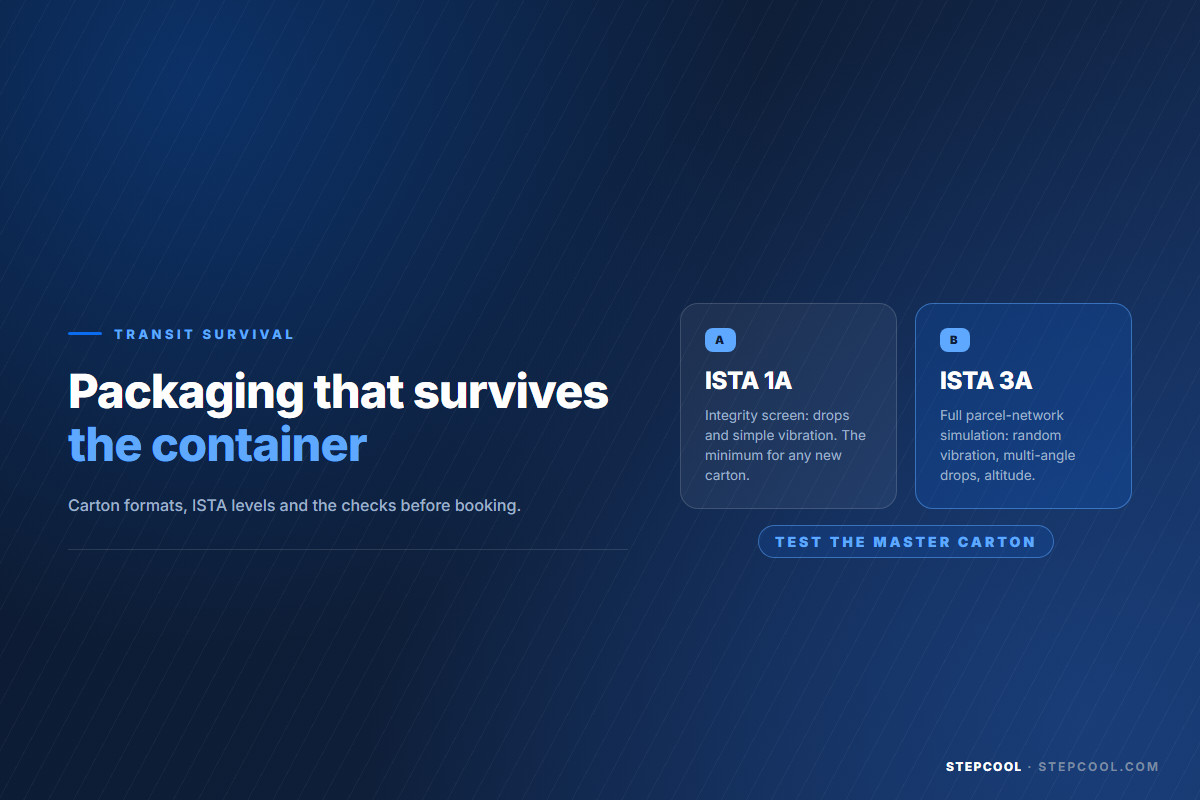
Dance mats fail in transit more than any other product in a games accessory line, and the reasons are structural: a large flat surface, printed graphics that crease, sensor layers that hate sharp folds, and cartons big enough to crush each other inside a container. Most damage claims trace back to packaging decisions made in ten minutes at the quotation stage. This guide covers the formats, the ISTA test levels worth specifying, and a checklist to run before booking.
1. How mats actually get damaged
- Vertical crush. Flat, wide master cartons stack badly: without vertical reinforcement, ten layers on a pallet turn the bottom cartons into the product's final quality inspection.
- Crease lines. A mat folded flat along the same line for six weeks at sea develops a memory crease that cracks print coating and can open the sensor layer at the fold.
- Humidity. Weeks in a closed container is a condensation cycle; laminated surfaces delaminate and flannel arrives with odour.
- Scuffing. Unprotected mats sliding inside a half-empty master carton wear the surface print before anyone unpacks them.
None of these are quality problems in the factory sense — a perfect mat can fail all four in one voyage. They are packaging problems, cheap to prevent at the specification stage and expensive to fix after the fact.
2. Folded flat, rolled, or rigid retail box?
| Format | Protection | Cube | Best for |
|---|---|---|---|
| Flat-folded, poly bag, master carton | Medium — crease risk at fold lines | Best | Value channels, promotional volumes |
| Rolled with insert tube | High for print and sensors | Roughly a quarter to a third more than flat | Premium, gift, educational channels |
| Rigid retail box, mat inside | Highest; the box also sells the product | Worst | Retail shelves where the box is merchandised |
The cube column is the one buyers underestimate: on a bulky product, a third more volume usually costs more in freight than the entire inner packaging budget. Run both options through the landed cost calculator before you decide — the answer differs by route and by order size.
3. ISTA levels in plain language
ISTA test series are the packaging industry's shared simulation scripts. Four levels matter for this category:
| Level | What it simulates | When to specify it |
|---|---|---|
| ISTA 1A | Non-simulation integrity test: drops plus simple repetitive vibration on the packed unit | Minimum screen for any new carton; the cheapest pass/fail signal |
| ISTA 2A | Partial simulation of general distribution — a fuller sequence with atmospheric conditioning | Container shipments to distributors and retail distribution centres |
| ISTA 3A | Full parcel-network simulation: random vibration, multiple drop orientations, altitude conditioning | Marketplace and parcel-channel products — the level worth quoting to customers |
| ISTA 6 (Amazon) | Amazon's own protocol for Ships in Product Packaging (SIPP) | Required if you ship in your own box without Amazon overboxing |
One practical rule when commissioning tests: test the master carton, not just the retail box. Retail units can pass while the pallet they travel in fails, and the claim lands on you either way. Ask the test house for the full sequence report — it shows which stage broke the packaging, which is exactly what you need in order to fix it.
4. What to specify beyond the test level
- Carton grade by number, not adjective. Specify minimum edge crush or bursting strength for the master carton; "strong carton" is not a specification.
- Poly bag rules. Bags above the regulated opening size need the suffocation warning printed; bag thickness and warning text belong in the spec sheet, especially for products sold into under-3 households.
- Desiccant for sea freight. One or two sachets per master carton for laminated or printed surfaces on long ocean legs; the cost is trivial and odour complaints are not.
- Inner separation. When several mats share a master carton, a board divider stops scuffing between units — cheaper than processing claims.
- Pallet discipline. Strap with corner boards, no overhang, and cap the stack height in the packing plan so nobody improvises twelve layers in the warehouse.
5. Carton cube and the margin you cannot see
A worked contrast, indicative rather than universal: a dance mat flat-folded into a poly pack and a rolled version in an insert tube carry the same product value, but the rolled format can push the container space a full order needs up by a quarter to a third. On a bulky product, that difference in freight share frequently exceeds a dollar per unit — far more than the insert tube itself costs. That number, not the inner packaging price, is the real cost of the "premium" decision, which is why the right answer is a per-SKU calculation rather than a house rule. The calculator handles duty, inspection and returns allowance alongside freight.
6. Labels and marks that prevent delays
- Shipping marks and carton numbering. "1 of 120", destination port, gross weight per carton — the warehouse reads these before it reads your packing list.
- Origin marking. "Made in China" on the retail box and, where required, on the product; customs will find it one way or another.
- Battery marks. Mats with rechargeable cells carry battery-related labelling and transport documentation; confirm the exact requirement for the cell and the route before printing the carton.
- Barcodes. For retail channels, place the GTIN flat, scannable and uncoated on the back panel; verify it from the barcode proof, not from memory.
7. A pre-shipment packaging check
- Stack the planned pallet height in the factory, then open and inspect the bottom carton.
- Flat-fold a sample five times along the pack crease; re-test every arrow and key afterwards.
- Roll a sample, leave it rolled for a week, then unroll and re-test.
- Drop a filled master carton from the height your ISTA level specifies, on corners and edges as well as faces.
- Shake a half-full master carton for two minutes; inspect the print for scuffing.
- Weigh and measure real cartons — update the shipping marks and freight math with actuals, not estimates.
- Check the poly bag warning rule against the bag size you are actually using.
- Scan one retail barcode with a phone and with a handheld scanner.
- Photograph the packed unit, the master carton and the pallet as the shipping record.
Steps 1 to 5 are the ones that predict claims; the rest prevent customs and channel friction. A factory that runs this routine unprompted is telling you something useful about how it ships.
Where STEP COOL fits
We pack dance mats and music mats to the channel: flat-fold formats for value lines across our wired dance mat range, and gift or retail packaging around products like the SC-DDR06 six-key music mat. Carton grade, desiccant, marks and pallet plans are part of the packing specification we issue with every order, and we support ISTA testing through third-party labs when your channel requires a report.
If you are comparing formats for a first order, send the route and quantity and we will return the cube and packaging cost for both options alongside the quote — then check the freight share yourself with the landed cost calculator. Related reading: the TV dance mat buying guide, how to choose a musical mat, and tooling costs and MOQ tiers.