
A runtime claim is the cheapest line to print on a box and the most expensive one to defend. "40 hours of play" is a performance statement, and in most markets a performance statement needs evidence you can reproduce on request. This guide covers how runtime is actually measured on a wireless controller, why two honest labs can end up a factor of two apart, and what to hold before a figure goes onto artwork.
Why runtime claims fail
Three failure modes account for almost every weak battery claim we see in a controller brief:
- The number came from the cell datasheet. A 1,000 mAh cell is not 1,000 mAh of playtime. Cell capacity is measured at a defined discharge rate and temperature; the controller adds a radio, LEDs, rumble motors and a boost converter, each with its own losses.
- The test conditions were never written down. A figure measured with vibration off, LEDs dimmed and the radio idle cannot be reproduced by a reviewer who actually plays a game. When someone asks "under what conditions", there is no answer.
- It was measured on one hand-built sample. Engineering samples usually carry the best-graded cell in the building. Production units spread 10–20% around the same nominal.
The consequence is not abstract. Marketplace compliance teams ask for the test report behind a listing claim, retail buyers ask for it in the vendor pack, and in the US an advertising claim needs competent and reliable evidence before it is made, not after a challenge. A claim you cannot reproduce is a refund liability with a print cost attached.
Fix the protocol before you fix the number
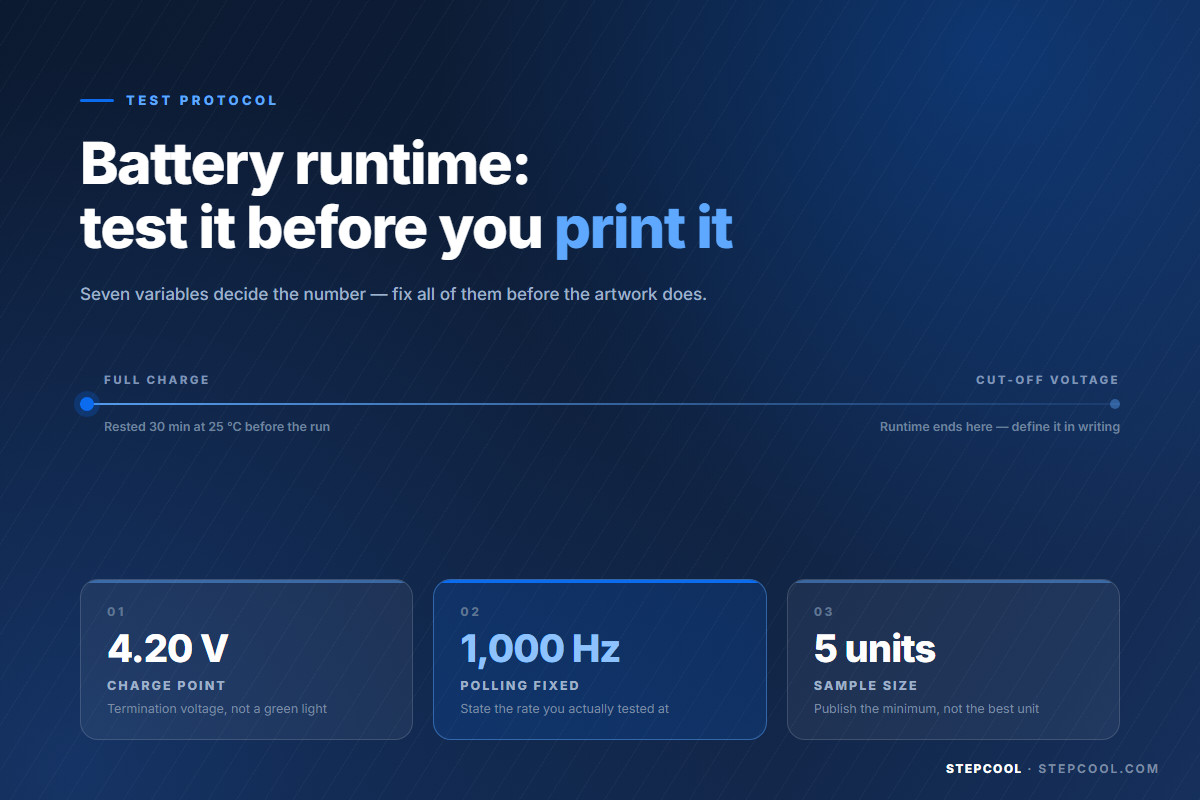
Runtime is a function of seven variables. Any one of them can move the result further than a firmware update will. Write all seven into the protocol and print them in the report:
| Variable | Why it moves the number | What to fix |
|---|---|---|
| Charge termination | A pack charged to 4.10 V holds noticeably less energy than one charged to 4.20 V | Charge to 4.20 V ±0.02, rest 30 minutes at 25 °C before discharge |
| Discharge profile | Idle time is nearly free; rumble and LEDs are not | Define a duty cycle, for example 30% idle, 60% input, 10% vibration |
| Connection mode | Bluetooth, 2.4 GHz dongle and wired draw differently | Test each mode separately and report each one |
| Polling rate | 1,000 Hz keeps the radio and the MCU busier than 125 Hz | State the rate; do not quietly lower it for the test |
| Vibration and lighting | Two motors and a full LED ring can dominate the power budget | State on or off, intensity and brightness level |
| Ambient temperature | Lithium-ion delivers less capacity when cold | 25 ± 2 °C as the reference; add a 0 °C run if you sell into cold markets |
| Cut-off voltage | Stopping at 3.4 V instead of 3.0 V throws away usable runtime | Discharge to the platform low-battery warning, then a defined grace period |
Two protocols are worth having, not one: a worst-case run (vibration on, LEDs at maximum, highest polling, dongle mode) and a mixed-use run that resembles how the product is actually played. The first protects you in a dispute; the second is the one you can honestly market.
The bench, in practice
You do not need a certified laboratory to produce a defensible number, but you do need to remove human variation from the test:
- Discharge with a programmable load or a console running a scripted input loop. A person pressing buttons is not a test method; the same person on a different day is a different load.
- Log voltage and current at fixed intervals. Every ten seconds is enough to compute consumed energy and to see the tail where the boost converter loses efficiency.
- Charge with the cable and adapter you ship. Fast-charge negotiation changes the last 20% of the charge, which is exactly where the runtime argument usually sits.
- Test the production firmware build, not an engineering build. Sleep current, LED behaviour and radio power settings are firmware decisions, as covered in our firmware customization guide.
- Control the room, not just the bench. A 5 °C swing across a workshop moves runtime further than most firmware tuning does.
Continuous load versus real gameplay: where 40 becomes 20
The gap between a marketing number and a review complaint is almost always the load profile. A controller at rest still burns current: the radio holds a connection, the MCU polls, the LED driver idles. Rumble motors are the largest discretionary load and the LED ring is second.
That produces a predictable shape. Idle-dominant testing with the radio at low power and vibration disabled can plausibly reach the "up to 40 hours" territory on a mid-size pack. A mixed-use run with vibration firing on hits and the ring at half brightness typically lands far lower, and a worst-case run with everything at maximum lands lower again.
Both numbers are true. Only one of them belongs in a headline. The defensible structure is a pair: "up to X hours" with the conditions printed in the same sentence, and "Y hours typical" with the protocol available on request. If a buyer asks which figure warranty should be modelled on, the answer is neither — it is the minimum across the sample, which is the next problem.
Sample size, spread and which number you publish
Production spread comes from cell grading, antenna placement and assembly tolerance. A 10–20% spread across five units is normal and is not a defect. What matters is which statistic you publish:
- Average — the honest marketing figure, and the basis for "typical".
- Minimum — the figure to plan warranty and support cost against, because the customer who complains owns the minimum.
- Maximum — never publish it. It describes the best unit on a bench, not a product.
Test at least five units from the production lot rather than from the engineering build, and re-run the test after any cell vendor or cell model change. A second-source cell with the same nominal capacity can have a different discharge curve, and the runtime difference shows up in the field rather than on the bench.
Nominal capacity and cycle life: what the cell numbers mean
Cell capacity is quoted at a defined discharge rate and temperature — commonly 0.2C at 25 °C for a lithium-ion pouch. A controller draws well below 1C, so rate effects are small, but the figure still assumes a full charge to 4.2 V and a discharge to the cell cut-off. If your firmware stops earlier to protect the cell or to avoid a brown-out when the radio peaks, usable capacity is lower than the label.
Cycle life is the other claim that gets copied without evidence. IEC 61960 is the reference standard for capacity and cycle testing of lithium-ion cells and batteries for portable applications; "80% of initial capacity after 500 cycles" means something only when the charge rate, discharge rate and temperature are stated alongside it. If a supplier cannot name the conditions behind a cycle claim, treat the claim as marketing and plan the warranty without it.
One more number buyers forget: self-discharge in storage. A controller that loses a third of its charge in a warehouse over three months generates returns that look like battery failures. Specify ship-mode current and measure it, not just the runtime.
Claim language and the evidence behind it
| Claim on the pack | Evidence that supports it |
|---|---|
| "Up to 40 hours" | Best-case run with the conditions printed alongside; "up to" is only safe when the conditions are disclosed |
| "40 hours playtime" | Mixed-use protocol report, minimum across at least five production units |
| "1,000 mAh" | Cell datasheet plus an incoming inspection record confirming capacity per lot |
| "2-hour charge" | Charge curve from cut-off to termination at the stated adapter rating |
| "500 cycles to 80%" | Cycle test under a named standard's conditions, or a traceable supplier report |
| "Rechargeable lithium-ion" | Cell chemistry, cell model and the UN38.3 test summary for transport |
The rule that keeps you out of trouble is simple: every number on the pack should map to a document you can send within one working day. If it does not, the number is a liability with a print cost.
Battery rules that reach the claim and the design
Two regulatory threads run alongside the test work. The first is transport: lithium cells and packs need a UN38.3 test summary before they fly, and that paperwork follows the shipment rather than the product. Our UN38.3 and air freight guide covers that path in detail, and the same logic applies to a controller with an installed pack.
The second is the EU Battery Regulation (EU) 2023/1542, which replaced the 2006/66/EC Battery Directive and applies from 18 February 2024. Its obligations arrive in phases rather than all at once: CE marking and conformity assessment for batteries from 18 August 2024, the separate collection symbol from 18 August 2025, and — the one with real design consequences — removability and replaceability of portable batteries built into appliances from 18 February 2027, subject to narrow exemptions. Labelling and capacity marking sit on their own timeline that depends on a pending implementing act, so confirm the current status before you print.
For a controller brand, the 2027 date is a tooling decision you are making now. A pouch cell glued into a housing behind a sealed battery door is an expensive retrofit; a screw-fixed door with a connector, or a replaceable cell compartment, is a shell change that is cheap before the mold is cut. If EU volume matters, settle it at the OEM design stage, not at the packaging proof.
How we test at Stepcool
We have built controllers and dance mats in Shenzhen Baoan since 2004, with production in Fuhai and Songgang and battery and electronics assembly in-house. Runtime and charge tests run per model against a written protocol, with a logged discharge curve and a report stating minimum, average and maximum across the sample, so the claim on your artwork is one you can reproduce.
The SC-Q34U shows why the protocol matters: dual TMR sticks, 1,000 Hz polling, four connection modes and adjustable vibration all change the power budget, and each mode gets its own line in the report. Wired and wireless variants of the same platform are compared in our wired versus wireless guide, and the reports we can share are listed on the certifications page.
If you have a runtime target for a new model, send it with your target markets and volumes through the quote form. We will tell you whether it is reachable on the cell size your housing allows before you commit to artwork — and if it is not, we will say so rather than print it.