
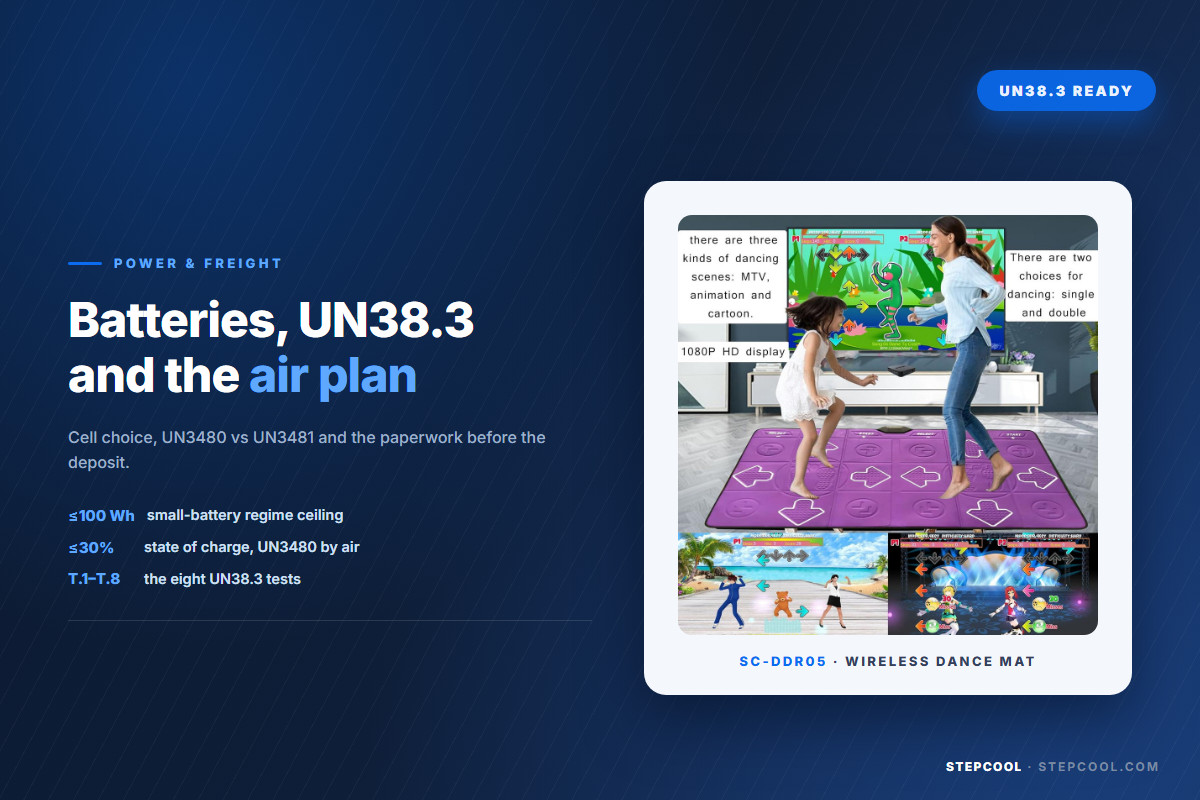
Adding a rechargeable battery turns a dance mat from a simple wired toy into a regulated dangerous good in transit. The difference shows up in three places buyers often forget to plan for: the cell choice in the BOM, the UN38.3 paperwork the freight forwarder will demand, and the air routing rules that decide how fast your order can leave Shenzhen.
This guide walks through the power options, what the UN38.3 test program actually covers, how UN3480 and UN3481 shipments are classified, and which documents to demand from your supplier before the deposit — written from the factory side for importers and product managers.
1. Which dance mats actually need a battery
Three power architectures exist in this category, and only one of them triggers lithium battery freight rules:
- Mains/USB powered — the most common TV mat configuration: the mat runs from a wall adapter or the console's USB port. No lithium rules apply. Most wired TV dance mats work this way.
- AA batteries — common on entry-level kids' mats. Dry cells sit outside the lithium regime; the product certifies more simply, but the consumer pays a recurring battery cost for the life of the product.
- Built-in rechargeable lithium — the standard choice for Bluetooth and portable mats that must work anywhere in the living room. This is the architecture the rest of this article is about.
Decide this before sampling. The choice changes the enclosure, the on/off behavior, the certification scope and the shipping plan all at once — and retrofitting a wired design into a battery design usually means redoing both tooling and paperwork.
2. Cell choice and the protection circuit
For mats, the practical choice is between a pouch cell and a cylindrical 18650, and the decision is mostly about shape and sourcing rather than chemistry marketing:
| Li-poly pouch | 18650 cylindrical | |
|---|---|---|
| Shape freedom | Flat — fits inside a rolled mat edge or the console box | Fixed cylinder, needs a holder |
| Cost at volume | Mid | Low — huge global supply |
| Sourcing quality spread | Wide; brand versus no-name matters a lot | Narrow; authentic cells easy to verify |
| Failure behavior | Swelling is visible before failure | Rigid; can crack holders under stress |
Whatever the cell, the non-negotiable part is the protection circuit board on the pack: overcharge, over-discharge, over-current and short-circuit protection. A pack without a PCM should be rejected at sample review regardless of price. A typical mat pack — 3.7 V at 2,000 to 4,000 mAh — lands between 7.4 and 14.8 watt-hours, comfortably under the 100 Wh ceiling that separates small lithium-ion batteries from the fully regulated regime.
3. What UN38.3 actually tests
UN38.3 is section 38.3 of the UN Manual of Tests and Criteria: eight tests applied at cell and battery level to prove a design can survive transport. It is a design qualification — a type test — not a 100% screen of every unit that ships:
| Test | What it simulates |
|---|---|
| T.1 Altitude | Low-pressure air transport and storage |
| T.2 Thermal | Extreme heat and cold cycling |
| T.3 Vibration | Truck and aircraft vibration |
| T.4 Shock | Impacts and drops during handling |
| T.5 External short | Terminals shorted at several temperatures |
| T.6 Impact / crush | Mechanical abuse of the cell |
| T.7 Overcharge | Charger failure (rechargeable cells) |
| T.8 Forced discharge | A cell drained by its neighbors in a series string |
The practical consequence: the cells and packs in your product must come from a cell maker whose design already carries UN38.3 results. Reputable cell brands supply these documents routinely. A no-name cell whose papers "will come later" is the single biggest red flag in battery sourcing.
4. How the shipment is classified: UN3480 vs UN3481
Lithium-ion batteries in transport carry UN number 3480 (batteries shipped alone) or 3481 (batteries packed with, or contained in, equipment). A dance mat with its battery installed ships as UN3481 — batteries contained in equipment — the least restricted of the air options. The rules live in the IATA Dangerous Goods Regulations as packing instructions PI 965 (batteries alone), PI 966 (with equipment) and PI 967 (in equipment), with lighter treatment for small batteries that meet watt-hour limits.
- State of charge — lithium-ion batteries shipped alone as UN3480 must travel at or below 30% state of charge and are restricted to cargo aircraft. Mats with the battery installed inside the equipment avoid this restriction.
- Marks and labels — small UN3481 shipments carry the lithium battery mark with the UN number on each carton; fully regulated shipments add Class 9 labels and a shipper's declaration.
- The DGR is revised annually — thresholds and packing details shift between editions, so confirm the current rules per booking with your forwarder instead of relying on last year's checklist.
Ask your forwarder one question early: "at what quantity per carton does this move out of the small-battery regime?" Quantity thresholds per package decide whether the consignment needs full dangerous-goods handling, and they belong in the packing plan — not in an afterthought at the port.
5. The paperwork to demand before the deposit
- UN38.3 test summary — the cell or battery test summary identifying the product and results. Test summaries must be made available on request under the UN requirements; treat a refusal as disqualifying.
- Safety data sheet (SDS) for the cell, so your forwarder can classify and book without guesswork.
- Cell brand and model in writing in the purchase order — packs are where substitution quietly happens between sample approval and mass production.
- Protection circuit specification — which PCM functions are fitted and at what thresholds.
- Product-level overlap — the battery adds scope to the rest of the compliance stack: toy standards for children's products, EU battery rules, and radio approvals if the mat is Bluetooth. Our compliance map and the documents on the certifications page show how those pieces fit together.
6. What the battery does to cost and schedule
Three line items change, and none of them is the cell itself:
- Certification — the battery widens product-level testing scope; budget for it at project start rather than discovering it mid-project.
- Freight — lithium handling can restrict routing and carrier choice, and forwarders charge for dangerous-goods paperwork once quantities exceed the small-battery regime. Model the delta in the landed cost calculator before you commit to a price.
- Pack assembly and ageing — packs are welded and checked separately from the mat line, which adds days to the 25–35 day mass-production window, and cell sourcing adds lead time ahead of it. That interacts with the MOQ economics described in the tooling and MOQ guide.
Against that: a rechargeable mat removes the recurring cost of disposables, enables Bluetooth use cases that otherwise do not work, and usually carries a retail premium that more than covers the compliance overhead. The comparison that matters is landed cost against the price your channel accepts.
7. Battery checklist for the purchase order
- Cell brand, model and rated capacity in the PO, with substitution requiring written approval.
- PCM functions and protection thresholds specified.
- UN38.3 test summary and SDS attached as order documents — not "available on request".
- Charger specification: input rating, connector, and the certification scope of the charger itself.
- Shipping configuration: battery installed (UN3481) versus shipped separately, and the per-carton quantity that keeps the consignment in the small-battery regime.
- Storage rules before dispatch — packs should ship at a sensible storage charge, not freshly full.
If you are weighing a battery build against a wired one, our SC-DDR05 and the wired SC-DDR03 sit on either side of that decision, and the wired versus wireless analysis from our controller line applies to mats for the same reasons. Tell us your target market and channel through the quote form and we will tell you which power architecture the market will accept — including when the honest answer is "stay wired".